
The Screening Process: Prescreening and Screening Candidates - ApplicantStack
The article from ApplicantStack explains that manual candidate screening hinders effective hiring by making it hard to compare applicants objectively, quickly identify qualified candidates, and manage the process efficiently, and advocates for a formalized screening process using tools like application questionnaires to improve quality of hire and reduce bias.
The Screening Process: Prescreening and Screening Candidates
May 28, 2019
Applicant Tracking, Recruiting Best Practices, Recruiting Software


A manual candidate screening process make hiring harder than it needs to be. Fortunately, it’s not difficult to create a formalized process. Does your candidate screening process affect quality of hire? Absolutely!
What Are the Challenges of Manual Candidate Screening?
Before we dive into the details of formalized screening, let’s explain why manual screening will stymie talent acquisition.
The Problems With Manual Candidate Screening
No way to compare one applicant from another
If you don’t have a screening process and resources, it’s difficult to compare candidates. This is one of the easiest ways to let bias creep into your process.
Inability to identify a pool of qualified candidates quickly
You don’t have time to engage with everyone (especially those without minimum qualification), so you need to isolate the cream of the crop. Application questionnaires are a great automated pre employment screening tool. When candidates apply, they self-filter by taking a carefully-designed questionnaire based on the job description and each necessary skill.
Difficulty keeping track of multiple job boards and sources
If you promote your job well, applications will flow in from many sites–careers page, social media, job boards, employee referrals and internal job seekers, outside agencies. if you don’t set up a process for organization, you may lose track of some great applicants.
No tool for tracking applicant stages
A candidate screening process is essentially a workflow that includes stages. These may include Application Received, Resume Review, Do Not Pursue, Phone Interview Complete, Pending Live Interview, etc. With no workflow, you have no hiring stages, and this will make it hard to know the status of each job seeker. To screen candidates efficiently, build a workflow based on your needs.
Inability to filter out unqualified candidates
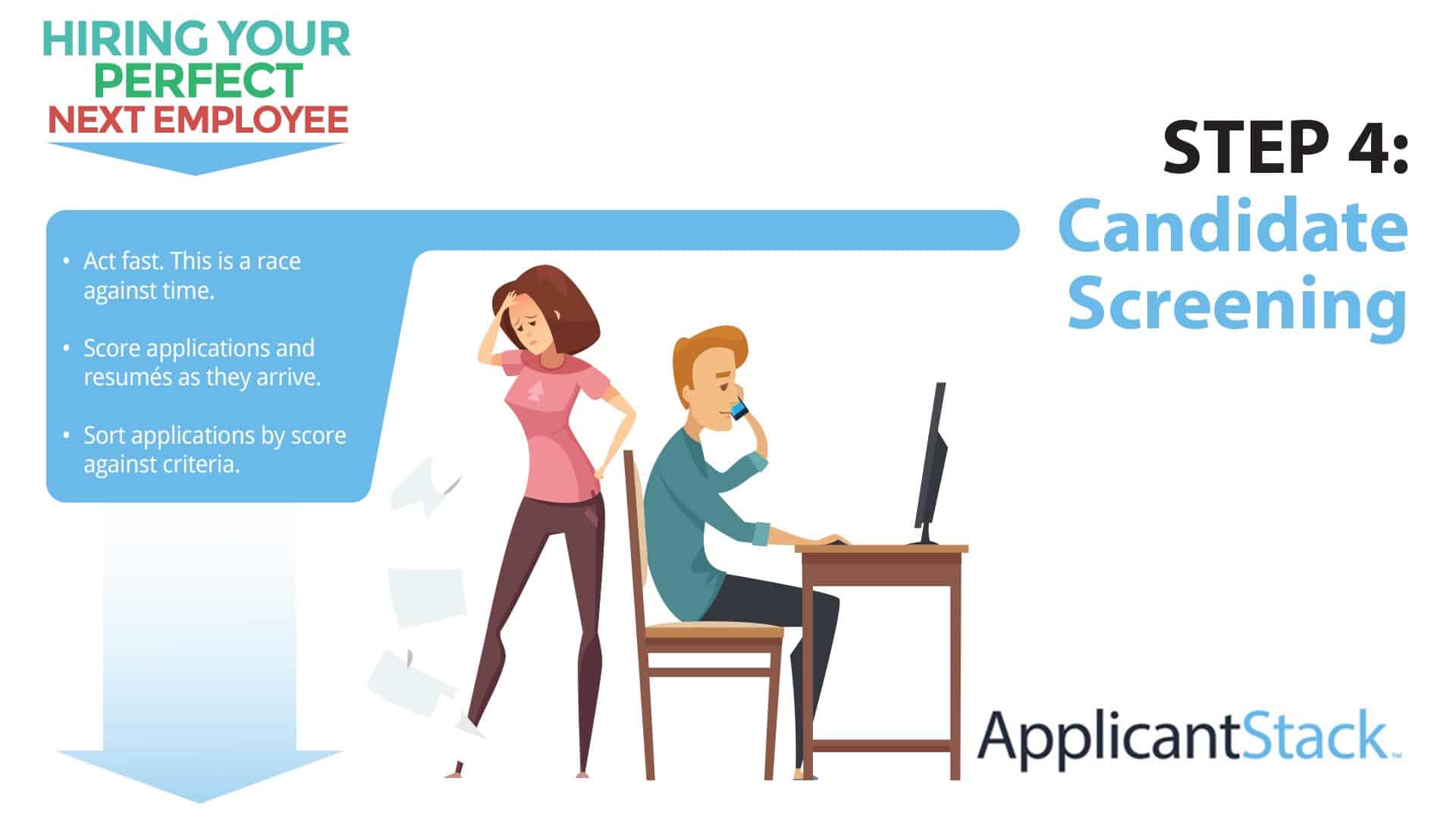
In today’s competitive hiring environment, you and your Human Resource team are in a race against time–spending precious hours engaging with unqualified applicants leaves less time for the top job candidate. Screening candidates automatically during the first pass gives you a head start. Using a formalized method for phone screen and interviews keep you on track.
EEOC compliance risks
If you can’t document a fair evaluation process, you are at risk of an EEOC challenge if a rejected job seeker suspects bias. In a way, this is a self-fulfilling disadvantage. Without a formal screening method, you ARE more likely to have a biased process. Consider, for example, if your hiring manager uses a ‘gut feeling’ to judge which applicant is a qualified candidate.
Difficulty collaborating with the hiring team
If each decision maker is using their own evaluation criteria for screening resumes or interviews, there is no way to tell which candidates are the most promising. In addition, as mentioned previously, this puts you at risk of bias, or at least the perception of bias. A disorganized team can’t identify a suitable candidate if they don’t even have a common benchmark.
What is Prescreening?
Now, let’s discuss the components of candidate screening. The first step is prescreening. This refers to evaluation that happens before any communication from the hiring team. As mentioned previously, this step can easily be automated. Using the job description, create a questionnaire that candidates will complete when they apply. Include elimination questions that filter out those who don’t meet the minimum qualifications.
Should you review resumes as part of the prescreening process? It will depend on the open position. If you are hiring for an entry-level opening, the questionnaire may suffice. Furthermore, if you are hiring for a high level position with relatively few applicants, you may want to take a look at the resumes. An applicant tracking system ATS can help you organize resumes and applications. Remember, however, not to base your decision solely on resumes–unless you are hiring a resume writer.
ATS search functions can help with resume review. Suppose you have 100 applicants and want to identify those with particular skills. Use keyword and boolean queries to zero in on your applicant pool.
Social Media Screening
Should you look at applicants’ social media sites? There isn’t a consensus among talent acquisition specialists. However, many employment law experts counsel waiting until after interviews if you insist on doing a social screening. A review of a candidate’s social media will reveal demographic information which shouldn’t be used in the hiring decision. If a rejected candidate accuses you of bias, you will have an easier time defending your decision if you interviewed all the top candidates–including those from underrepresented groups. For more protection, don’t have a decision maker do the social review. Bottom line, seek legal counsel to design a policy.
The First Screening Interview
Most hiring teams do the first interview as a phone call. The purpose of this interview is to isolate the group of candidates to move to the next step. For example, verify the skills and qualifications listed on the candidate’s resume. It’s also an ideal method to evaluate communication skills.
Useful questions for the phone screen include:
- Tell me about yourself.
- Why are you applying for this job?
- Why are you leaving your current position?
- What are your salary requirements?
- (For jobs that require travel) Are you willing to travel?
- What type of work environment are you looking for?
Notice that you can eliminate even high quality candidates if their salary expectations don’t match up or if they don’t want to travel and the position requires it.
Additional Screening
Every company has different hiring needs. Some do verification of the candidate before the first interview. These may include:
- Calling of references
- Background checks
- Credit history checks
- Education credentials
- Prior work performance
How do you know which screens to perform before the interview? Review previous hiring experiences. If a relatively high percentage of previous candidates have failed the background screen, move that up in the process. It will save you time in the long run. If something in a job seeker’s application raises a red flag–say educational experience listed–check it out.
In-Person or Video Interview
At this stage, you should have a pool of great candidates: 1. They weren’t eliminated by the filtering questionnaire due to lack of qualifications, and, 2. They weren’t eliminated in the phone screen.
The best practice for all interviews is structured interviewing scripts. They allow you to compare candidates using the same yardstick and protect you legally.
Before we continue, let’s review where we are in the series:
-
Candidate Screening

Content Marketing Manager at Swipeclock
Content strategist and corporate blogger (2000+ posts). Her work has been featured on G2's Learning Hub, Human Resources Today, CloserIQ, Better Buys and over 500 business websites. She plays bluegrass mandolin and enjoys hiking in the red rock wilderness of southern Utah. Connect with me on LinkedIn
Latest posts by Liz Strikwerda ( see all)
- ApplicantStack Featured in Case Study of Home Health Agency & Hospice - November 17, 2022
- Ask Me Anything Recap: How To Configure Job, Candidate and Application Fields - November 17, 2022
- 3 Ways Hiring Software Saves Money for Your Small Business - September 29, 2022

Allie Blackham|Aug 5, 2026
Building an effective hiring process from scratch involves identifying your company’s needs and setting a path to find quality applicants. By examining past hiring practices and implementing new strategies, you can build a more efficient process. Read on for some ways to create a hiring process that gets results. Primary Elements of the Hiring Process […]

Allie Blackham|Jul 29, 2026
The need for high-volume, non-exempt roles in the retail, food service, and healthcare support sectors often outpaces companies’ abilities to hire quickly. In these busy industries, shifts can run 24 hours, and turnover is frequent, creating a challenge for hiring managers. If degree or experience requirements are creating a barrier to finding quality candidates, consider […]

Allie Blackham|Sep 30, 2026
Background checks help small businesses avoid costly hiring mistakes, from resume fraud to license misrepresentation. They help small businesses reduce hiring risk, but running them legally means following FCRA disclosure rules, EEOC anti-discrimination protections, and your state’s fair-chance hiring laws. What Are Background Checks? Employment background checks typically use a third-party professional screening service to verify […]

Verified First|Sep 23, 2026
Guest Post by Verified First Do you screen every candidate the same way? That approach is costing you more than you think. A templated process feels efficient, but it wastes budget on low-risk roles. Worse, it under-protects your safety-sensitive ones. Most organizations don’t catch this until a compliance issue or a safety incident hits. As […]

Allie Blackham|Sep 16, 2026
Shortening time-to-hire reduces the burden on hiring staff and helps you reach top talent faster. Small businesses can use any help they can get to make the hiring process more efficient. An applicant tracking system shortens time-to-hire by automating screening, scheduling, and offer letters, cutting out the manual steps that create the biggest bottlenecks for […]

Allie Blackham|Sep 9, 2026
Q4 tends to hit hiring teams like a freight train. Retail ramps up for the holidays, e-commerce warehouses struggle to keep pace with order volume, and hospitality prepares for back-to-back events. If your applicant pipeline isn’t ready for that surge, you may end up losing out on great candidates and revenue. Here are six steps […]

Allie Blackham|Sep 2, 2026
If your open roles are pulling in three or four times the applications they did two years ago, you’re not imagining it. AI writing tools have made it easier than ever for job seekers to customize a resume and cover letter for every posting in seconds. “Apply to everything” browser extensions allow candidates to blast […]

Allie Blackham|Aug 26, 2026
The hiring process takes time and money, both of which can be tight in small business budgets. When a candidate ghosts you at any stage, it can be demoralizing and expensive. Here are some ways to keep communication flowing to avoid being abandoned by quality prospects. What Is Candidate Ghosting? Ghosting refers to a scenario […]

Allie Blackham|Aug 19, 2026
Hiring new employees is no small task: it takes hours of company time and money to recruit, interview, and select top talent. Once you’ve got a new employee on board, you want to turn that hiring investment into a good experience for both of you. That’s where onboarding comes in. Read on for some effective […]
Allie Blackham|Aug 11, 2026
When someone walks out your office door for the last time, they’re taking valuable insights with them. The question is: will you capture those insights before they’re gone forever? An exit interview represents one of the most underutilized opportunities in business. Done right, it can reveal blind spots in your management, uncover systemic issues, and […]
Allie Blackham|Aug 5, 2026
Building an effective hiring process from scratch involves identifying your company’s needs and setting a path to find quality applicants. By examining past hiring practices and implementing new strategies, you can build a more efficient process. Read on for some ways to create a hiring process that gets results. Primary Elements of the Hiring Process […]
Allie Blackham|Jul 29, 2026
The need for high-volume, non-exempt roles in the retail, food service, and healthcare support sectors often outpaces companies’ abilities to hire quickly. In these busy industries, shifts can run 24 hours, and turnover is frequent, creating a challenge for hiring managers. If degree or experience requirements are creating a barrier to finding quality candidates, consider […]
Allie Blackham|Sep 30, 2026
Background checks help small businesses avoid costly hiring mistakes, from resume fraud to license misrepresentation. They help small businesses reduce hiring risk, but running them legally means following FCRA disclosure rules, EEOC anti-discrimination protections, and your state’s fair-chance hiring laws. What Are Background Checks? Employment background checks typically use a third-party professional screening service to verify […]
Verified First|Sep 23, 2026
Guest Post by Verified First Do you screen every candidate the same way? That approach is costing you more than you think. A templated process feels efficient, but it wastes budget on low-risk roles. Worse, it under-protects your safety-sensitive ones. Most organizations don’t catch this until a compliance issue or a safety incident hits. As […]
Make Recruiting and Onboarding Easy
See for yourself! Fill out the form to start a trial today and see how ApplicantStack can improve your hiring and onboarding processes.
This field is for validation purposes and should be left unchanged.
-
First Name*
-
Last Name*
-
Company Name*
-
Phone Number**
-
Business Email*
Watch for your free trial log-in information coming to your inbox!
*You agree to receive SMS messages about your Free Trial.
-
Watch for your free trial log-in information coming to your inbox!
-
*
-
I understand this not a job application and I am based in the US or Canada.
Entiendo que esto no es una solicitud de empleo y que resido en Estados Unidos o Canadá.
-
Start your free trial
Δ
We use cookies to ensure that we give you the best experience on our website. If you continue to use this site we will assume that you are happy with it.OK
Notifications