
How to Master New Hire Orientation
The article emphasizes that mastering new hire orientation is crucial because a structured onboarding process significantly enhances employee productivity, retention, morale, and overall organizational performance, yet many companies lack such frameworks, leading to inefficiencies and missed revenue.
How To Master New Hire Orientation
Dec 17, 2025
ApplicantStack, Blog, Employee Onboarding


Updated December 17, 2025
Employee onboarding isn’t just an HR task; it’s a critical investment an organization makes in its future quality and performance. Many companies underestimate the power of a structured new hire strategy. This is unfortunate because the consequences of an inefficient or disjointed new hire orientation can directly hit productivity and profitability.
The Importance of New Hire Orientation
Ask an employer or executive if onboarding and orientation are important, and they’ll probably say, “Yes.” However, actions don’t always follow these words. In fact, 36% of employers don’t have a structured onboarding process at all. And if you ask employees, you’ll find that just 12% of them say their organization has a good onboarding process. This can be a real issue, because the absence of a clear framework can have myriad negative effects, such as:
- Decreased productivity.
- Greater operational inefficiencies.
- Poor employee retention.
- Lower team morale and engagement.
- Missed revenue targets.
This confirms a simple truth: to minimize risk and maximize results, you must ensure your new employees feel supported, confident and engaged from day one. Implementing a strong new hire orientation plan is the essential first step.
Orientation vs. Onboarding: Why the First Day Matters
Both onboarding and orientation can be critical to the future success of a new employee, but they’re not synonyms. It’s important to distinguish between the two.
- Onboarding is the full, ongoing process — often lasting 30 to 90 days — of integrating a new employee into a company, its culture and their new role.
- Orientation is a crucial component of onboarding, typically a one-time event on the first day. It’s an organization’s opportunity to make a powerful first impression on new personnel, providing them with a high-level overview of the hierarchy, key stakeholders and immediate expectations.
What Makes a Successful Orientation?
Every organization will have aspects of its orientation that are unique to it. However, broadly speaking, a successful first-day orientation should achieve four core goals:
- 1.Instill confidence and comfort: Starting a new job can be stressful. Your orientation should put new hires at ease, making them feel comfortable and valued, which is the foundation for future loyalty.
- 2.Boost engagement and speed-to-competency: By providing quick access to key information, necessary tools and introductions, you speed up new hires’ learning curve. Engaged employees become confident, productive contributors faster.
- 3.Clearly define expectations: Regardless of prior experience, new staff need clarity on your way of doing business. Tailoring the orientation to the specific role ensures they understand their responsibilities and possess the immediate resources to perform well.
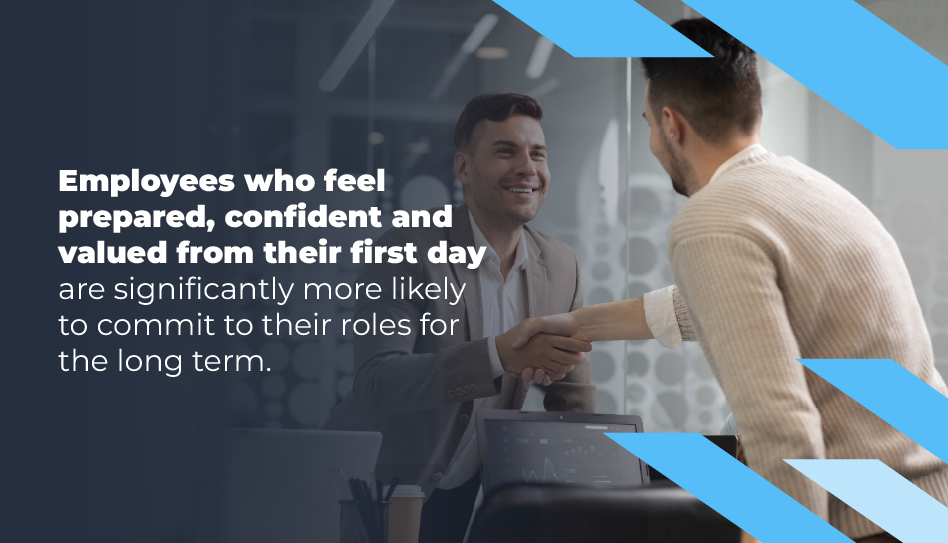
- 4.Reduce costly employee turnover: Employees who feel prepared, confident and valued from their first day are significantly more likely to commit to their roles for the long term. This directly protects your recruiting investment.
Essential Content for Your New Hire Orientation
The exact style of your orientation will depend on your company size and industry, but by keeping the following core elements in mind, you can increase your new hire’s chances of achieving early — and long-term — success:
Culture, Mission and Values
This is the “why” behind your company. New hires need to know your core values to understand business goals and align their work ethic accordingly. Sharing your specific mission ensures everyone is working toward the same standard of customer service and operational excellence.
Management Structure and Introductions
A walkthrough of your organizational chart is imperative. Introduce new employees to the executive leaders and relevant managers within the company. If possible, incorporate prominent executives — even for just a 10-minute video call or personalized welcome video — to share key insights and make the new hire feel connected to leadership.
Role-Specific Information
New hires often require immediate, practical tools. This includes departmental contact information, instructions on how to access necessary systems and where key resources or files are stored. This eliminates any “Where do I start?” frustration.
Policies, Procedures and Compensation
Cover the non-negotiables early on. Essential policies to review include:
- Safety and security procedures.
- Paid time off policies.
- Equal employment opportunity guidelines.
- Other relevant company policies outlined in the employee handbook.
Ensure every new hire receives a digital or paper copy of the employee handbook and signs an acknowledgment stating they have received and reviewed it. Also, clearly outline their compensation and any benefits packages, such as healthcare or retirement plans, supplied equipment or wellness support.
Best Practices for Maximizing Orientation Success
Successful onboarding often begins with a hiring process centered on the candidate experience and extends to a careful and deliberate orientation. To ensure your new hire satisfaction remains high, follow these best practices for implementation:
1. Strategize Your Timing
Schedule your orientation sessions during your company’s quieter periods. For example, if Mondays and Fridays are typically busy, set the orientation for early on a Tuesday or Wednesday. This informed scheduling minimizes distractions, allowing both new hires and managers to focus fully on the session.
2. Share a Clear Agenda in Advance
Eliminate first-day anxiety by providing a clearly formatted agenda ahead of time. Email incoming staff a timetable that breaks down the first day and week. A structured plan ensures the initial stage goes smoothly and helps new hires arrive feeling prepared. Include a thoughtful welcome message to set a positive tone.
3. Encourage Hands-On Interaction
Ditch the passive, all-day lectures. Your goal is engagement. Incorporate a mix of participation-based activities to make the orientation fun and memorable, such as:
- Quick group quizzes on policies.
- Team-based games related to company history.
- Open Q&A sessions with senior team members.
4. Schedule Dedicated One-on-One Time
Even if orientation involves a group, individual meetings are beneficial. Set aside time for the direct manager to meet with new hires face-to-face. This personalized welcome helps managers connect on a personal level and provides a private space for the new hire to ask questions and share any concerns.
5. Leverage Software To Streamline the Process
The biggest drain on a hiring manager’s time during orientation is manual paperwork and coordinating across departments. This is where technology saves you time and reduces risk.
Onboarding software offers an all-encompassing solution that simplifies, streamlines and enhances the entire process. It eliminates the hassle of paper forms, keeps records digitally organized and ensures all teams (HR, IT, managers, etc.) are in the loop.
The ApplicantStack Advantage: Seamless Onboarding
Good onboarding tools are invaluable to your small business. ApplicantStack is a powerful applicant tracking system and hiring platform with robust onboarding features built right in.
Our comprehensive solution allows you to:
- Import new hires seamlessly: Data flows automatically from the initial application right into the onboarding phase, eliminating manual data entry errors.
- Build bespoke checklists: Create and manage unique, paperless onboarding checklists for each job position or work location, ensuring compliance and consistency every time.
- Simplify documentation: Use templates and digital signature capabilities to automate form submission and record keeping.
Take your onboarding efficiency to new heights and reduce the administrative burden on your team.
Sign up for a free trial of ApplicantStack today and turn your hiring process into a competitive advantage.

Latest posts by Allie Blackham ( see all)
- How to Reduce Time-to-Hire Effectively - September 16, 2026
- Seasonal Hiring Playbook: Scaling Your Workforce for Q4 - September 9, 2026
- All About the AI Application Flood: How Small HR Teams Can Keep Up - September 2, 2026

Allie Blackham|Jul 22, 2026
One of the most important metrics in your hiring process is time-to-hire. Discovering where your company experiences delays and bottlenecks can help you apply best practices to shorten the metric overall. Consider some of the ways to attack this problem head-on. What Is Time-to-Hire? Time-to-hire refers to the number of days between a candidate’s application […]

Allie Blackham|Jul 15, 2026
Onboarding a new employee benefits both them and the company. Implementing a robust onboarding procedure not only makes new hires feel welcome, but it creates an important bond of trust that affects retention rates. Consider evaluating ways to improve your company’s onboarding process. What Is Onboarding? Onboarding is the step that follows job acceptance: it’s […]

Allie Blackham|Sep 16, 2026
Shortening time-to-hire reduces the burden on hiring staff and helps you reach top talent faster. Small businesses can use any help they can get to make the hiring process more efficient. An applicant tracking system shortens time-to-hire by automating screening, scheduling, and offer letters, cutting out the manual steps that create the biggest bottlenecks for […]

Allie Blackham|Sep 9, 2026
Q4 tends to hit hiring teams like a freight train. Retail ramps up for the holidays, e-commerce warehouses struggle to keep pace with order volume, and hospitality prepares for back-to-back events. If your applicant pipeline isn’t ready for that surge, you may end up losing out on great candidates and revenue. Here are six steps […]

Allie Blackham|Sep 2, 2026
If your open roles are pulling in three or four times the applications they did two years ago, you’re not imagining it. AI writing tools have made it easier than ever for job seekers to customize a resume and cover letter for every posting in seconds. “Apply to everything” browser extensions allow candidates to blast […]

Allie Blackham|Aug 26, 2026
The hiring process takes time and money, both of which can be tight in small business budgets. When a candidate ghosts you at any stage, it can be demoralizing and expensive. Here are some ways to keep communication flowing to avoid being abandoned by quality prospects. What Is Candidate Ghosting? Ghosting refers to a scenario […]

Allie Blackham|Aug 19, 2026
Hiring new employees is no small task: it takes hours of company time and money to recruit, interview, and select top talent. Once you’ve got a new employee on board, you want to turn that hiring investment into a good experience for both of you. That’s where onboarding comes in. Read on for some effective […]
Allie Blackham|Aug 11, 2026
When someone walks out your office door for the last time, they’re taking valuable insights with them. The question is: will you capture those insights before they’re gone forever? An exit interview represents one of the most underutilized opportunities in business. Done right, it can reveal blind spots in your management, uncover systemic issues, and […]

Allie Blackham|Aug 5, 2026
Building an effective hiring process from scratch involves identifying your company’s needs and setting a path to find quality applicants. By examining past hiring practices and implementing new strategies, you can build a more efficient process. Read on for some ways to create a hiring process that gets results. Primary Elements of the Hiring Process […]

Allie Blackham|Jul 29, 2026
The need for high-volume, non-exempt roles in the retail, food service, and healthcare support sectors often outpaces companies’ abilities to hire quickly. In these busy industries, shifts can run 24 hours, and turnover is frequent, creating a challenge for hiring managers. If degree or experience requirements are creating a barrier to finding quality candidates, consider […]
Allie Blackham|Jul 22, 2026
One of the most important metrics in your hiring process is time-to-hire. Discovering where your company experiences delays and bottlenecks can help you apply best practices to shorten the metric overall. Consider some of the ways to attack this problem head-on. What Is Time-to-Hire? Time-to-hire refers to the number of days between a candidate’s application […]
Allie Blackham|Jul 15, 2026
Onboarding a new employee benefits both them and the company. Implementing a robust onboarding procedure not only makes new hires feel welcome, but it creates an important bond of trust that affects retention rates. Consider evaluating ways to improve your company’s onboarding process. What Is Onboarding? Onboarding is the step that follows job acceptance: it’s […]
Allie Blackham|Sep 16, 2026
Shortening time-to-hire reduces the burden on hiring staff and helps you reach top talent faster. Small businesses can use any help they can get to make the hiring process more efficient. An applicant tracking system shortens time-to-hire by automating screening, scheduling, and offer letters, cutting out the manual steps that create the biggest bottlenecks for […]
Allie Blackham|Sep 9, 2026
Q4 tends to hit hiring teams like a freight train. Retail ramps up for the holidays, e-commerce warehouses struggle to keep pace with order volume, and hospitality prepares for back-to-back events. If your applicant pipeline isn’t ready for that surge, you may end up losing out on great candidates and revenue. Here are six steps […]
Make Recruiting and Onboarding Easy
See for yourself! Fill out the form to start a trial today and see how ApplicantStack can improve your hiring and onboarding processes.
This field is for validation purposes and should be left unchanged.
-
First Name*
-
Last Name*
-
Company Name*
-
Phone Number**
-
Business Email*
Watch for your free trial log-in information coming to your inbox!
*You agree to receive SMS messages about your Free Trial.
-
Watch for your free trial log-in information coming to your inbox!
-
*
-
I understand this not a job application and I am based in the US or Canada.
Entiendo que esto no es una solicitud de empleo y que resido en Estados Unidos o Canadá.
-
Start your free trial
Δ
We use cookies to ensure that we give you the best experience on our website. If you continue to use this site we will assume that you are happy with it.OK
Notifications